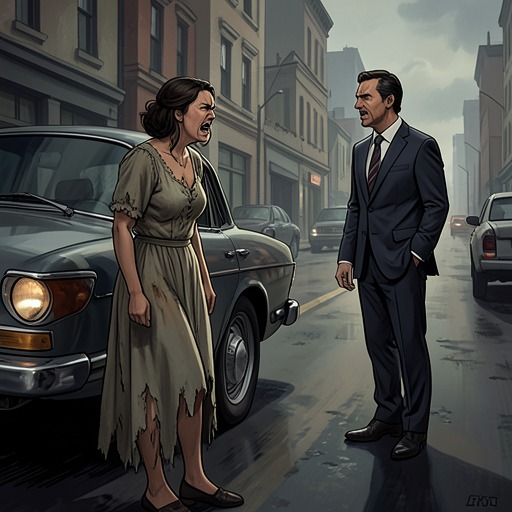
June Habersaat–Alberte Enmity
The Hanging GirlJune Habersaat’s enmity toward Alberte Goldschmid began as a rivalry over Frank Brennan and culminated in June deliberately driving into Alberte. June believed Frank had chosen Alberte over her; rather than accept the loss, she watched the pair, learned their private habits, and used that knowledge to draw Alberte into the collision. The relationship is therefore defined less by a mutual conflict than by June’s fixation on a rival who, in June’s account, stood between her and the life she had expected with Frank.
The Rivalry Takes Shape
June understood that Frank had been seeing Alberte while still involved with her. She recognized the affair through the perfume on him when he came to end their relationship, and later concluded that she had noticed its trace on earlier occasions too. What hurt most, she said, was that the relationship had overlapped: Alberte was not simply the woman Frank chose afterward but someone he had already been seeing while June believed they were together.
June responded by following Frank and observing how he and Alberte stayed in touch. Their notes were left beside a large boulder in front of the school, a place the investigators had passed repeatedly without knowing its significance. June connected that exchange to the messages she and Frank had once left at the place where they made love. The detail makes the rivalry concrete: two relationships, one secret method of communication, and a familiar landmark that had concealed the connection in plain sight.
The conflict sharpened when June went to find Frank at the commune at Ølene. He told her directly that he was in love with Alberte and intended to take her back with him to Copenhagen. June recalled hating Frank for the rejection and Alberte just as much for being the person he had chosen. Her resentment was not only directed at a lost romance; it attached itself to Alberte as the obstacle to the future June still wanted.
From Jealousy to a Plan
June later admitted that she wanted Alberte removed from Frank’s life before the move to Copenhagen. She imagined Alberte’s beauty as something that could be destroyed and believed that if Alberte were no longer in the picture, Frank might return to her. That hope endured long after the attack: June said she waited for years for him to come back, while eventually refusing to hear about him from her ex-husband, her sister, or the investigators. Her own account thus joins an immediate, violent plan to a prolonged attachment to the possibility of reconciliation.
The plan depended on intimate knowledge of Alberte’s routine. June knew that Alberte went out every morning before the others were awake, even when no message had been left. Early one morning, before driving to Aakirkeby, June placed a note under the boulder and forged Frank’s handwriting. The false message exploited the very correspondence June had watched: Alberte would recognize the apparent invitation as part of her private connection with Frank and go to the familiar meeting place.
The Collision
June borrowed her son Bjarke Habersaat’s car while he was at work at a workshop in Aakirkeby. He normally left it in front of June’s sister’s house, where he ate lunch each day. At the roadside, June made it appear that she was steering around Alberte. Alberte smiled at the driver of a snowplow bearing an inscription, although there was no snow and Christmas was still more than a month away. June then jerked the steering wheel and drove into her, striking Alberte first and her bicycle afterward.
The deception and the collision formed one continuous act: the forged note brought Alberte to the road, and the feigned attempt to pass concealed June’s decision to hit her. June described the morning as very early and emphasized that people on Bornholm took things slowly, circumstances that help explain why she believed no one else would witness what happened. The attack turned her desire to ruin Alberte’s appearance and remove her as a rival into an act with fatal consequences.
Discovery and Family Consequences
June’s concealment began to unravel because Karin Kofoed saw her put the plow back in the car’s trunk. June later said that Karin threatened for years to report what she had seen. After returning to Listed, June put the plow back; the following day, she learned that Karin had told Bjarke she had seen June with it and knew she had borrowed the car. By then, the search for Alberte had already begun. Karin’s observation connected the borrowed vehicle and the hidden equipment to June, even as June later disputed Karin’s account of who had been angry with whom.
That evening, June, Bjarke, and Christian Habersaat sat together at dinner when Christian announced that he had found Alberte in a tree and that the discovery had left a terrible impression on him. June could tell that Bjarke had worked out what she had done. He did not tell his father, but June understood his silence as a failure of loyalty to Christian, and she linked it to his later inability to continue living under the same roof as his father after she moved out a few months afterward. Bjarke lived for a time with Karin and with June in Aakirkeby before finding a place of his own.
Meaning of the Enmity
The relation between June and Alberte is reconstructed through June’s own confession, which makes its one-sidedness significant. June describes watching, comparing, and resenting Alberte; the evidence does not establish that Alberte knew June was following her or understood the danger behind the notes. Alberte’s ordinary morning habit and apparent trust in Frank’s message become the means by which June exploits her.
The boulder carries the rivalry from private betrayal into physical action. It had served as a meeting point for lovers’ notes, first for June and Frank and then for Alberte and Frank; June’s forged message turns that shared practice into a trap. The collision also leaves consequences beyond the two women: Karin’s observation threatens exposure, and Bjarke’s knowledge fractures his place in the Habersaat household. June’s hostility toward Alberte thus persists not merely as jealousy but as the concealed act that shapes what her family knows, withholds, and can no longer live together around.